
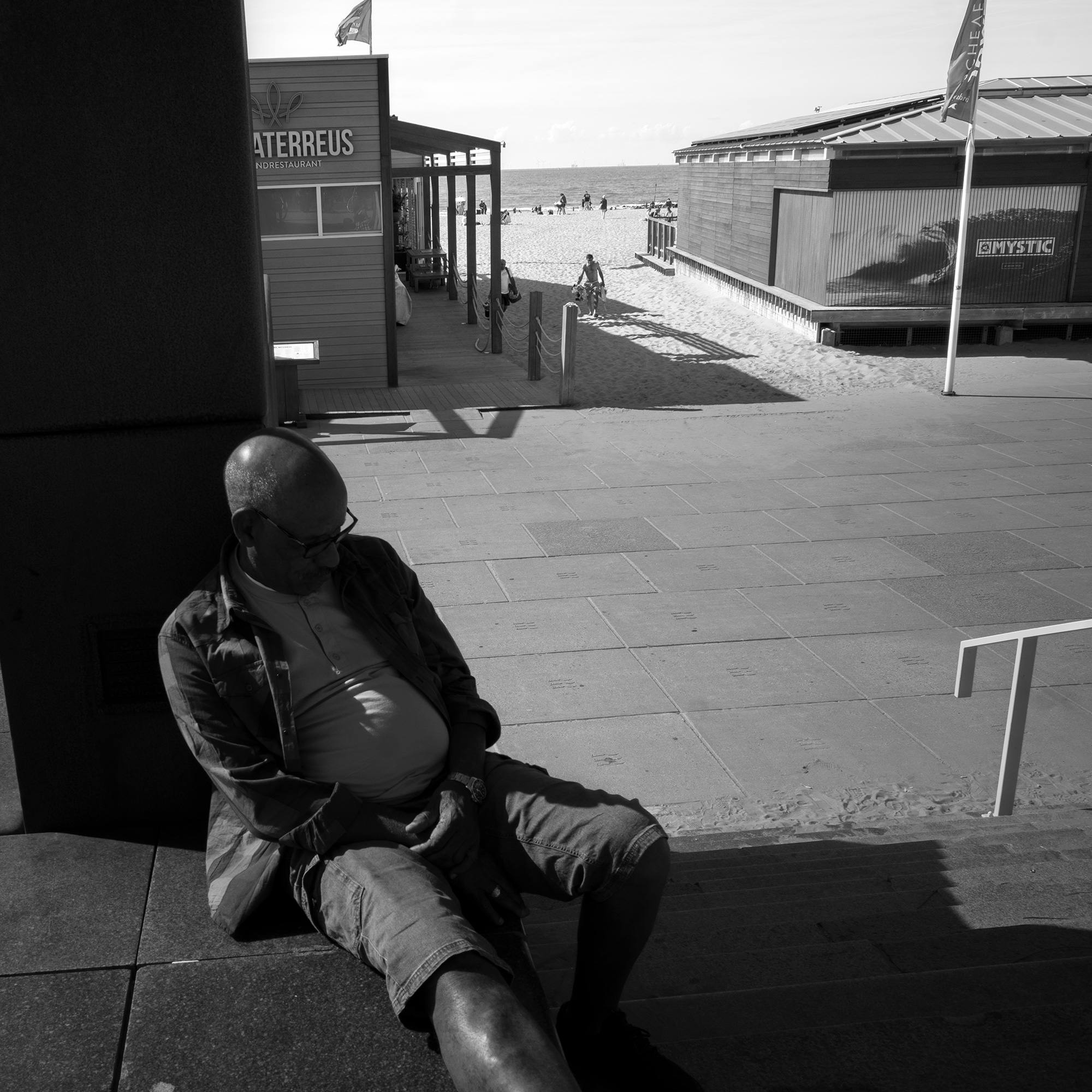
This photograph was taken on the promenade in front of Beach Restaurant De Waterreus at Strandweg 3A, Scheveningen (The Hague)—where the city’s hard lines soften into sand, sea, and sky. In the distance you’re looking across Scheveningen’s Noorderstrand, with the Scheveningen Lighthouse (Vuurtoren) nearby as a steady landmark on the coast.
The scene is simple and honest: a quiet human pause in the shade, strong sunlight carving out long shadows, and beach life carrying on in the background. It’s the kind of moment Scheveningen offers constantly—a resort atmosphere built on top of a working coastline.
Chilling at Scheveningen’s Noorderstrand (Strandweg 3A)
Within a short stroll of this spot, you can feel Scheveningen’s history in layers:
- A coast that had to be read and respected
Long before beach bars and boardwalks, this shoreline was about navigation, warning lights, and survival at sea. The lighthouse stands as a reminder that this is still a maritime edge—beautiful, but never tame. - From fishing village to seaside destination
Scheveningen grew from a community tied to the sea into a place where recreation, hospitality, and coastal identity meet. The beach culture you see today sits on top of generations who worked this water for a living. - Harbor influence, always close
Even when you can’t see the port directly, its presence is felt in the flows of people, deliveries, seasonal structures, and the practical planning that keeps the coast functioning.
Street photography here clicks when you shoot it as a transition zone:
city → promenade → sand → sea.
Each step changes the light, the pace, and the body language of people.
Infrastructure and what’s changing
Scheveningen is not static. It’s a place that is constantly being maintained, upgraded, and re-shaped.
Boulevard works and access routes
Parts of the boulevard are being renewed in phases, which can change how you move through the area: temporary paths, shifted entrances, and new sightlines as the promenade evolves. That means the same location can look dramatically different month to month—perfect for repeat visits with a camera.
_04.jpg)
Development around the harbor approach
Plans in the wider Strandweg/harbor-edge zone aim to strengthen the area as a year-round destination, mixing public space, hospitality, and improved connections. For photographers, that usually means more movement, more contrast, and more moments—especially around transitions like construction edges, detours, and temporary layouts.
Beach nourishment (replenishment): the coast is “rebuilt” on purpose
Scheveningen’s wide sands aren’t only the result of nature—they’re also the result of planning.
Beach nourishment is the process where dredgers pump sand from the North Sea and spray it onto the beach to widen and strengthen the coastline. It helps counter erosion, supports the dunes, and reduces storm risk.
What this looks like in real life:
- fresh, bright sand with fewer footprints
- new ridges, slopes, and edges along the shoreline
- temporarily altered routes and beach entrances
- different distances between promenade and water
If you return often, you’ll notice: the beach is never exactly the same set.

A changing horizon: offshore wind turbines
Look out to sea and the view is evolving.
Offshore wind energy—electricity generated by wind farms built in bodies of water—has added a new element to the seascape: modern wind turbines on the horizon. On clear days, they can become a repeating pattern behind beachgoers, turning the background into a quiet statement about the future of the coast.
It’s a striking contrast:
- old coast → lighthouse, harbor logic, weathered materials
- new coast → renewable energy, engineered beaches, redesigned public space
Shooting Notes
Use the shade as your stage.
In harsh seaside sun, the best stories often happen just out of the light.
Try this:
- Stand where shade meets sun and wait for someone to enter the edge
- Expose for highlights so the bright sand holds detail
- Let the background breathe—small figures in the distance add context without stealing the moment
- Watch for triangles and diagonals (steps, rails, shadows) to guide the viewer toward the sea
One strong subject + one clean horizon + one calm gesture
is often all you need for a frame that feels timeless.
.jpg)