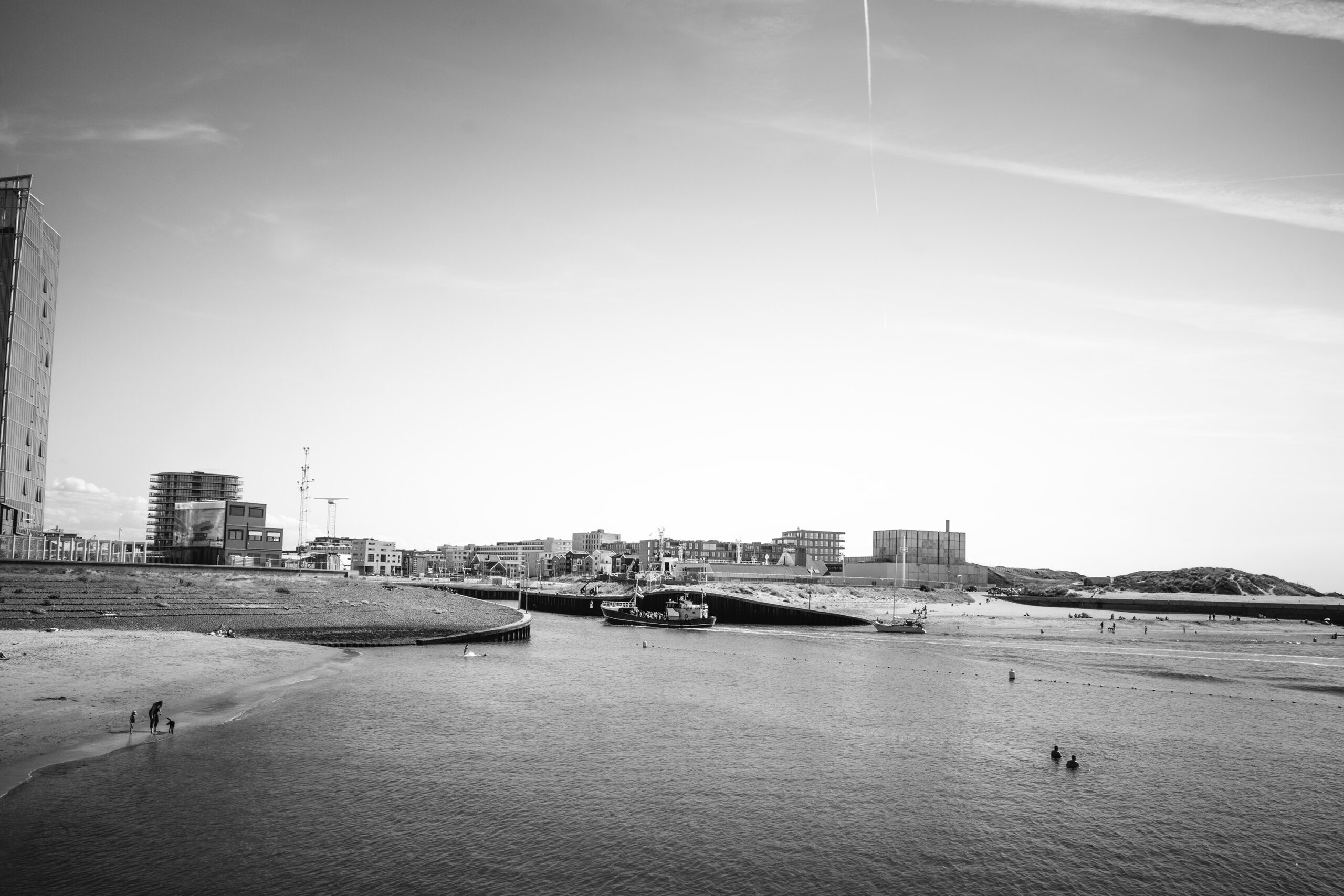
Black-and-white panoramas love places with strong lines and open sky—and the Scheveningen harbor heads deliver exactly that in the Scheveningen harbor area. At the edge of The Hague, the Noordelijk Havenhoofd and Zuidelijk Havenhoofd frame the harbor mouth like two long arms reaching into the North Sea, creating a compact scene packed with geometry, scale, and everyday movement. Add wet sand, wind, boats, and the occasional wildlife surprise near Het zeehondenstrandje, and you’ve got a coastal location that rewards photographers who work the frame patiently and build their shots in layers.
.jpg)
Scheveningen Harbor Heads & the Seal Beach: A Coastal Photo Spot in The Hague
Black-and-white panoramas thrive on clean lines, big skies, and real-life movement—and Scheveningen delivers all three. This panoramic photograph captures Het zeehondenstrandje (the “seal beach”) from the Noordelijk Havenhoofd (North Harbor Head), looking across the harbor entrance toward the Zuidelijk Havenhoofd (South Harbor Head)., where The Hague’s working harbor meets the wide North Sea. It’s a compact stretch of coastline where industry, weather, wildlife, and everyday life share the same horizon—perfect fuel for street and urban photographers who like their scenes honest and unpolished.
_Scheveningen_(6061638238).jpg)
Where you are: two long arms reaching into the North Sea
A havenhoofd is the end of a breakwater or pier that reaches into the sea to protect a harbor entrance and calm the water for ships. In Scheveningen there are two—north and south—forming a sheltered mouth between them. From this viewpoint, the scene is always shifting: tidal flats and wet sand, boats sliding through the channel, gulls riding the wind, people pausing at the waterline, and the hard geometry of rails, ramps, and harbor walls carved against a huge sky.
That mix—moving subjects + strong structure—is exactly what makes a panorama here feel alive instead of static.
.jpg)
The immediate surroundings: sand pockets, sheltered water, and urban edges
What makes this area photograph so well is the contrast packed into a single frame:
- Sheltered inlets and small beaches tucked inside the harbor heads—calmer water, mirror-like wet sand, and quieter moods than the open North Sea.
- Working harbor energy: small vessels, navigation markers, and repeating industrial shapes that read beautifully in black & white.
- Dunes and wind just beyond the built edges—low sandy rises and scrubby plants that feel almost wild beside the city.
- A city backdrop always present in the distance, even when your frame feels like pure coastline.
One important note for visitors: conditions change fast here. Wind and surf can make the harbor heads feel exposed, and access can be restricted during rough weather. Always respect gates, closures, and warning signs.
.jpg)
Nature at the seal beach: why it matters (and how to keep it that way)
Despite the nickname, the chance of actually seeing seals here is small—this is still a busy coastal zone with shifting conditions and human traffic. But seals do sometimes haul out on quiet sand pockets near the harbor structures, especially when they can rest without disturbance.
When it happens, treat it as a privilege: seals come ashore to sleep, warm up, and recover energy. Stressing them can push them back into cold water when they most need rest.
If you visit with a dog: leash up when seals are present
This area also has small “hangout beaches” where people walk dogs and watch boats. Dogs may be off-leash at times, but if you spot seals, leash your dog immediately and give the animals plenty of space. Dogs and resting seals are a bad combination, and even a brief disturbance can push tired animals back into the water.

What you might spot: animals and plants in this coastal pocket
This isn’t a pristine nature reserve—it’s an urban edge habitat. That’s what makes it interesting. Life here is tough, wind-driven, salt-soaked, and surprisingly varied if you slow down and look.
Seals (rare, but possible)
- Harbor seals are the most likely seal you’d see.
- Grey seals can appear too—larger, often more rugged-looking.
Photography tip: If seals are present, switch to “quiet mode.” Use a longer lens, keep your movements slow, and don’t try to improve your angle by closing distance. A respectful frame beats a close one every time.
.jpg)
Birds that fit this landscape
The harbor heads and rock blocks are magnets for coastal birds. Depending on season and weather, you may see:
- Gulls and terns slicing through wind lanes
- Small shorebirds working the tide line
- Winter visitors that blend into sand and stone, rewarding patient watching
Photography tip: In black & white, birds become graphic punctuation marks. Let the frame stay simple—then wait for the wingbeat.
.jpg)
Coastal plants (small, tough, and photogenic)
Look down near the dunes and sheltered edges and you’ll notice plants adapted to salt spray and shifting sand—low-growing, resilient species that survive where softer plants can’t. In the right light, they add foreground texture and scale to a wide panorama.
Photography tip: A thin strip of wind-bent vegetation in the foreground can turn a big sky panorama into a layered composition.

Future plans: what’s changing around the Noordelijk Havenhoofd
Scheveningen’s north harbor head sits in an area that has been undergoing long-term improvements and redevelopment—aimed at keeping the harbor functional while making the surrounding public space more welcoming for visitors. Over time, this typically means new paths, new buildings, reworked dunes and landscaping, and a more defined visitor experience.
Nature-inclusive design: why photographers should care
When redevelopment respects the coastal character—using dune-like landscaping, habitat-friendly details, and plantings that fit the environment—the area can become more photogenic, not less: more seasonal variation, more texture, and more life along the edges. When it doesn’t, places get smoother, cleaner, and visually bland. For photographers, the hope is simple: keep the rough poetry intact.

Why this location works so well in photography (especially black & white)
A strong panorama here is built from three ingredients:
- Structure: long lines (harbor walls, shore curves, horizon bands)
- Timing: boats moving, walkers pausing, birds cutting through wind
- Light: coastal haze and open sky that simplify tones
Black & white fits Scheveningen harbor scenes because it turns the view into shape, spacing, and moment. Wet sand becomes a gradient. Concrete becomes rhythm. Small figures and boats become scale.
.jpg)
A few practical shooting ideas
- Shoot the tide: low tide gives reflective sand and longer leading lines.
- Stay moving: change your height and angle—small shifts make big differences in panoramic balance.
- Use one lens and commit: wide for the full sweep; short tele for layered detail (boats, birds, hands, shadows).
- Respect wildlife: if you do see seals, keep distance—and leash your dog.

Visiting tips: what to look for when you arrive
- Best moments: early morning quiet, or late day when sky contrast and harbor lights start to matter.
- Safety: stones can be slippery; wind can spike quickly; access may be restricted.
- Leave no trace: the seal beach works because it stays restful.

Ready to photograph Scheveningen’s harbor heads? Come for the bold breakwater lines, wide North Sea skies, and the meeting point where harbor life touches the beach. Build your frames in layers—use wind-bent dune plants or wet sand in the foreground, place people or boats in the midground, and let the horizon and sky carry the background for a clean, cinematic look. Whether you’re chasing a minimalist black-and-white panorama or small, unscripted moments, Scheveningen in The Hague delivers coastal street photography that feels real—because it is.
2 Replies to “Scheveningen Harbor Heads: Street Photography at the Seal Beach in The Hague”
Comments are closed.