Het Natuurhistorisch — A dead serious museum
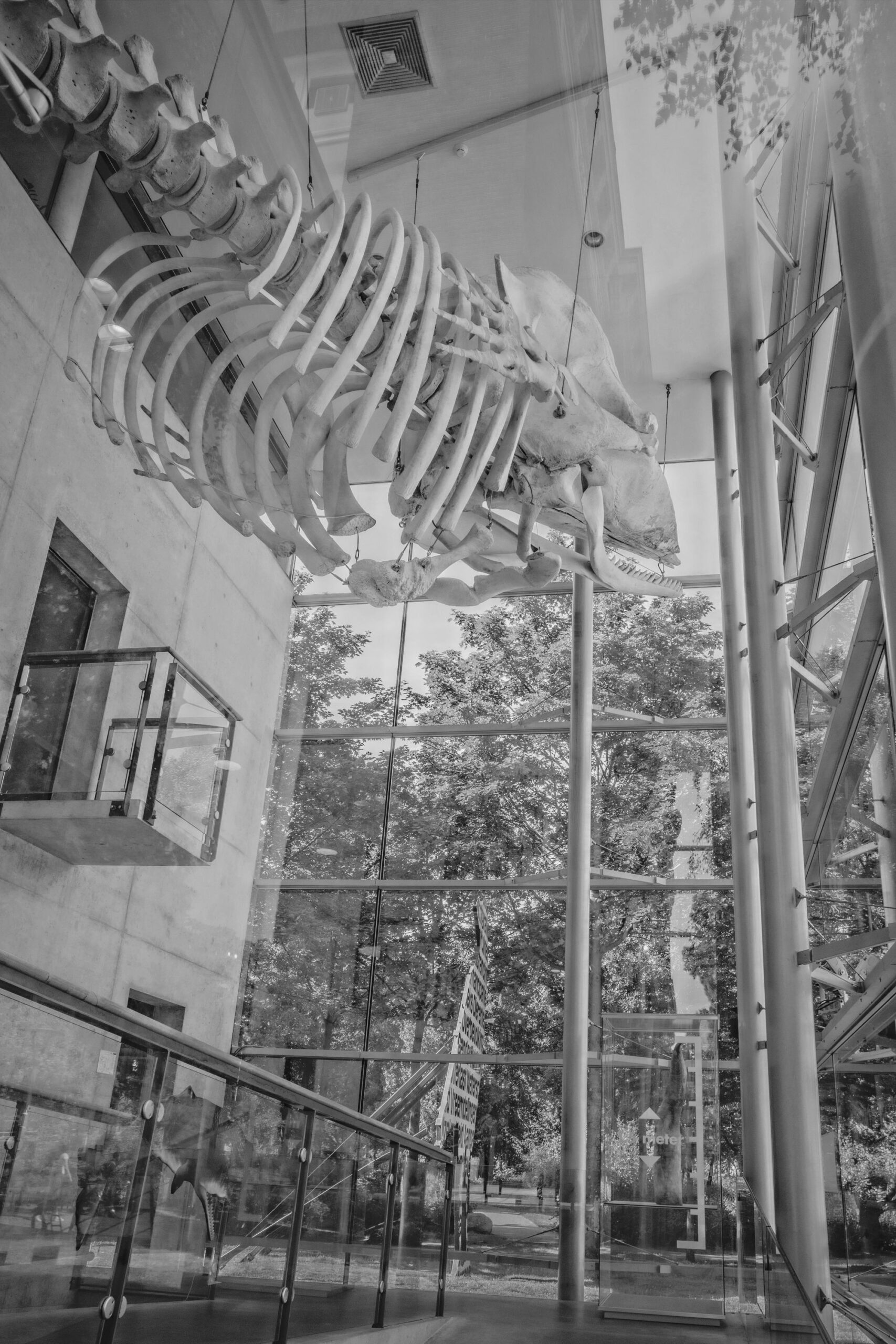
In Rotterdam, even a museum foyer can feel like street photography territory. A suspended whale skeleton turns an everyday passageway into a stage where architecture, daylight, and passing city life meet—quietly dramatic, and unmistakably urban.
Location and why it belongs on a street-photography map
This photograph was made at the Natural History Museum Rotterdam (Het Natuurhistorisch ) in Museumpark, near Westzeedijk, surrounded by Kunsthal Rotterdam, Het Nieuwe Instituut (and Huis Sonneveld), the Chabot Museum, and Museum Boijmans Van Beuningen with the Depot Boijmans Van Beuningen nearby. The museum’s entrance area—part lobby, part glass pavilion—functions like a public threshold: people arrive from the park, pause, look up, reorient, and move on. That “in-between” quality is exactly what street and urban photography thrives on. You’re not only documenting an exhibit; you’re documenting how Rotterdam frames experiences: bold, direct, and designed to be encountered in motion.
.jpg)
A floating landmark: when nature becomes city-scale
The whale skeleton reads like a landmark more than a specimen. Hung overhead, it borrows the language of the built environment: arcs, beams, and ribs echoing the lines of columns and window frames. The sensation is almost architectural—like a bridge made of bone. In cities, scale is storytelling. A subject this large turns the viewer into a character, even if no one appears in the frame. It suggests footsteps, conversations, and the tiny gestures people make when confronted with something enormous: slowing down, tilting their head, raising a phone, or simply walking beneath it without looking—because cities train us to normalize the extraordinary.

Glass, concrete, and the urban “vitrine” effect
The building itself shapes the photograph. Glass opens the interior to the park, concrete anchors the space, and reflections stitch the two together. The result is a layered scene: inside and outside happening at once. That layering is a core urban theme—Rotterdam as a city of surfaces, transparency, and engineered viewpoints. In the image, the skeleton becomes the foreground narrative, while the trees beyond the glass offer a softer counterpoint: life continuing, seasons turning, the city breathing outside. It’s a reminder that urban photography isn’t limited to sidewalks; it’s about how public spaces choreograph our attention.
.jpg)
Light as a co-author: timing matters more than gear
This kind of scene rewards patience over equipment. The whale’s pale bones catch daylight quickly, while the background can shift from crisp to hazy depending on cloud cover and angle. Bright sun gives hard contrast and graphic ribs; overcast light softens everything into a quieter, more contemplative mood. Move a few steps and the image changes: reflections intensify or disappear, exterior foliage becomes a texture or a distraction, and the skeleton’s silhouette separates (or merges) with the window grid. Treat the lobby like a street corner—watch the light, wait for the atmosphere, and shoot when the space feels balanced.

Composing the “urban anatomy”
The most compelling compositions here often rely on three simple elements: curve, grid, and depth. The skeleton provides sweeping curves; the architecture provides a strict grid; and the glass provides depth through layers. A low angle emphasizes scale and makes the ribs feel like a tunnel. A slightly off-center framing can create tension between the whale’s organic form and the building’s engineered order. You can also use vertical columns as measuring sticks, letting them visually “support” the suspended body. If you want the image to feel more documentary, include hints of human infrastructure—handrails, stairs, signage—so the viewer senses that this is a lived-in public space, not a sealed gallery.

Turning a single subject into a small story
A strong urban photograph often carries more than one idea at once. Here, you can build a short series without leaving the spot:
- A wide establishing frame that shows the whale against the glass and trees.
- A mid-frame that compresses ribs and window lines into patterns.
- A detail of jaw, vertebrae, or fastening points that reveals the “how” of suspension.
- A moment with a passerby (if permitted and respectful) to translate scale into human terms.
This approach matches the Point ’n Shoot ethos: one location, multiple moments. Return at different times, and the space tells different versions of itself—morning clarity, afternoon glare, rainy-day reflections, winter branches, summer leaves. The scene stays the same, but the city’s mood keeps rewriting it.
When you’re shooting a striking subject in a public space, don’t settle for the obvious “first wow” frame. Make three deliberate variations: (1) change your distance (wide, medium, close), (2) change your angle (low, eye-level, slightly high), and (3) change your background (clean, layered, busy). This simple three-step routine forces you to explore the scene like a street photographer—finding structure, context, and meaning, not just a subject.