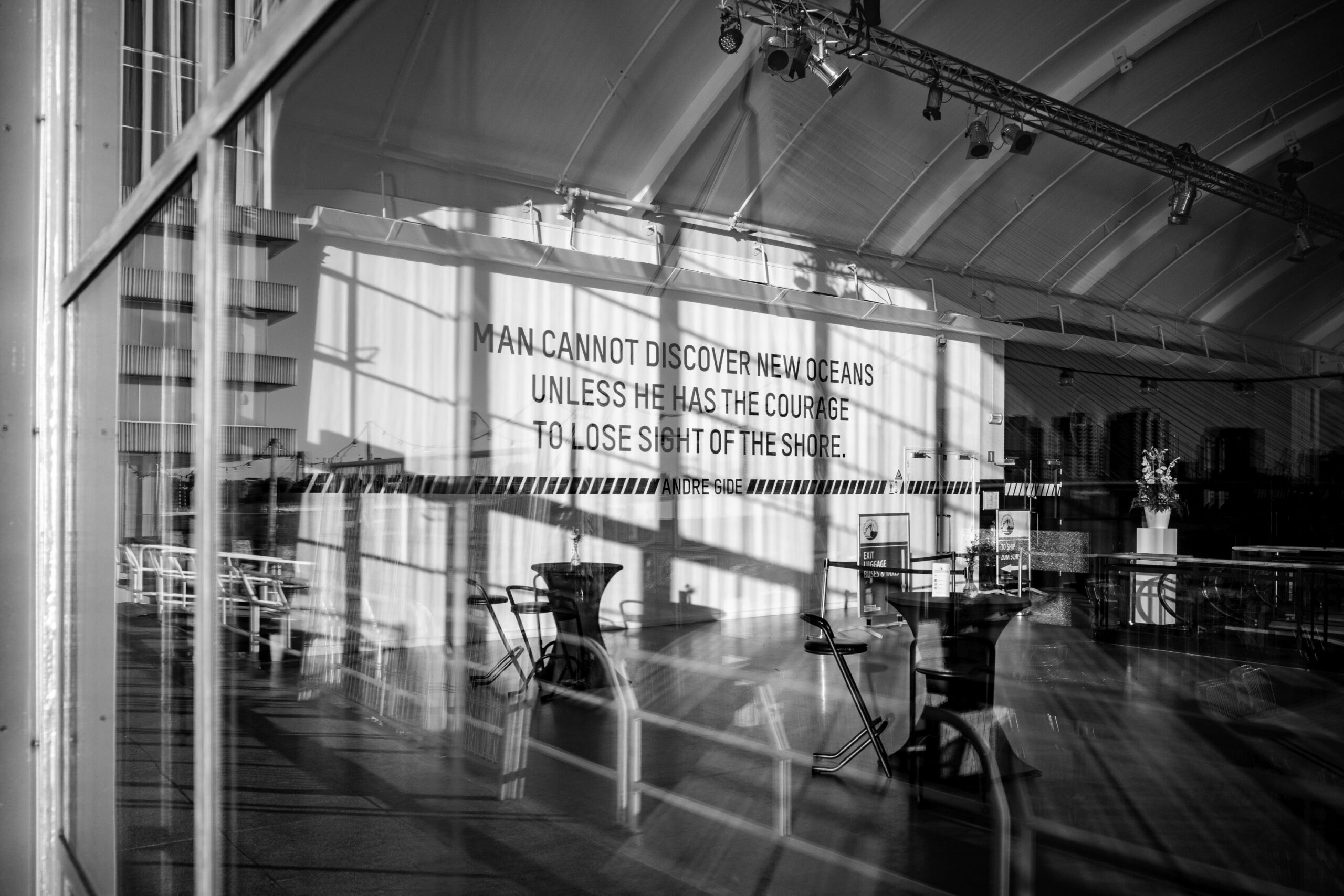
Dudok Aan De Maas offers one of the most distinctive viewpoints on Rotterdam’s post-war modern architecture. Located on the rooftop terrace of the historic Cruise Terminal on the Wilhelminakade, this spot reveals a rare perspective into the building’s raw industrial interior—where structure, rhythm, and function take center stage. From Dudok Aan De Maas (Note: Page is in Dutch), visitors and photographers can experience the contrast between Rotterdam’s polished skyline and the honest, utilitarian architecture that emerged during the city’s reconstruction years. It’s a location where history, design, and urban atmosphere come together, making it a compelling place to explore Rotterdam’s architectural identity from both inside and out.
Post-War Modern Architecture Rotterdam: Wilhelminakade—Cruise Terminal Photo Location
This photo was taken from the rooftop terrace at Dudok Aan De Maas, tucked into the first arch of Rotterdam’s Cruise Terminal on the Wilhelminakade. From up there you get a rare angle: instead of photographing the terminal only as a riverside landmark, you’re looking into its raw, post-war industrial interior, where beams, lines, and structure become the subject. It’s a striking contrast—Rotterdam’s polished skyline outside, and inside a robust shell of modern architecture that still carries the atmosphere of the city’s rebuilding years.

Loods Rotterdam: Post-War Modern Architecture (1946–1949)
The Cruise Terminal building is the former Holland America Line arrival hall, known as “Loods Rotterdam.” Built just after WWII (1946–1949) and designed by Jan Brinkman, Jo van den Broek, and Jaap Bakema, it is now a protected national monument. That status makes sense the moment you start observing the space. The architecture communicates purpose first: strong geometry, practical materials, and an honest, functional layout. If you enjoy post-war modernism, this location offers a clear visual language—less decoration, more structure, more rhythm.
_Cruise_Terminal_Rotterdam_2025-06-04.jpg)
1950s Departure Hall: The Human Story Behind the Building
In the 1950s, the terminal was one of Rotterdam’s great departure points. Thousands of migrants left from here by steamship for a new life in America, and the emotional weight of that history still lingers. Even when you visit as a photographer, the building encourages you to slow down and look. You can imagine the anticipation and uncertainty that once filled these halls—luggage in hand, final goodbyes, tickets checked, and one last glance back at a city reinventing itself. That echo is part of what makes this a special Rotterdam photo location: the architecture doesn’t just frame images, it carries a story.
_in_Rotterdam.-025.jpg)
Photo Composition: Inside the Cruise Terminal’s Industrial Interior
What makes this image compelling is the view into the Cruise Terminal’s industrial interior from the rooftop terrace at Dudok Aan De Maas. From this angle, the architecture becomes the subject: strong structural lines, repeating forms, and a raw, functional atmosphere that reflects Rotterdam’s post-war modernism. Compose your frame to highlight repetition and symmetry, then use texture and depth—beams, shadows, and layered spaces—to guide the eye inward. As the daylight shifts, the interior changes character too, revealing new contrasts and details that can transform the mood from graphic and minimal to dramatic and cinematic.

Nieuwe Maas & Erasmus Bridge Views
And then there are the views. From this rooftop terrace you can look out over the Nieuwe Maas toward the Erasmus Bridge, adding a distinctly Rotterdam signature to your shots. The river brings movement and scale; the bridge adds drama and immediate recognition. Together, they turn this into a standout location where you can alternate between architectural detail and wide cityscape without changing position. If you like telling visual stories, it’s an ideal setup: history beneath you, contemporary Rotterdam ahead of you, and the river connecting both.
