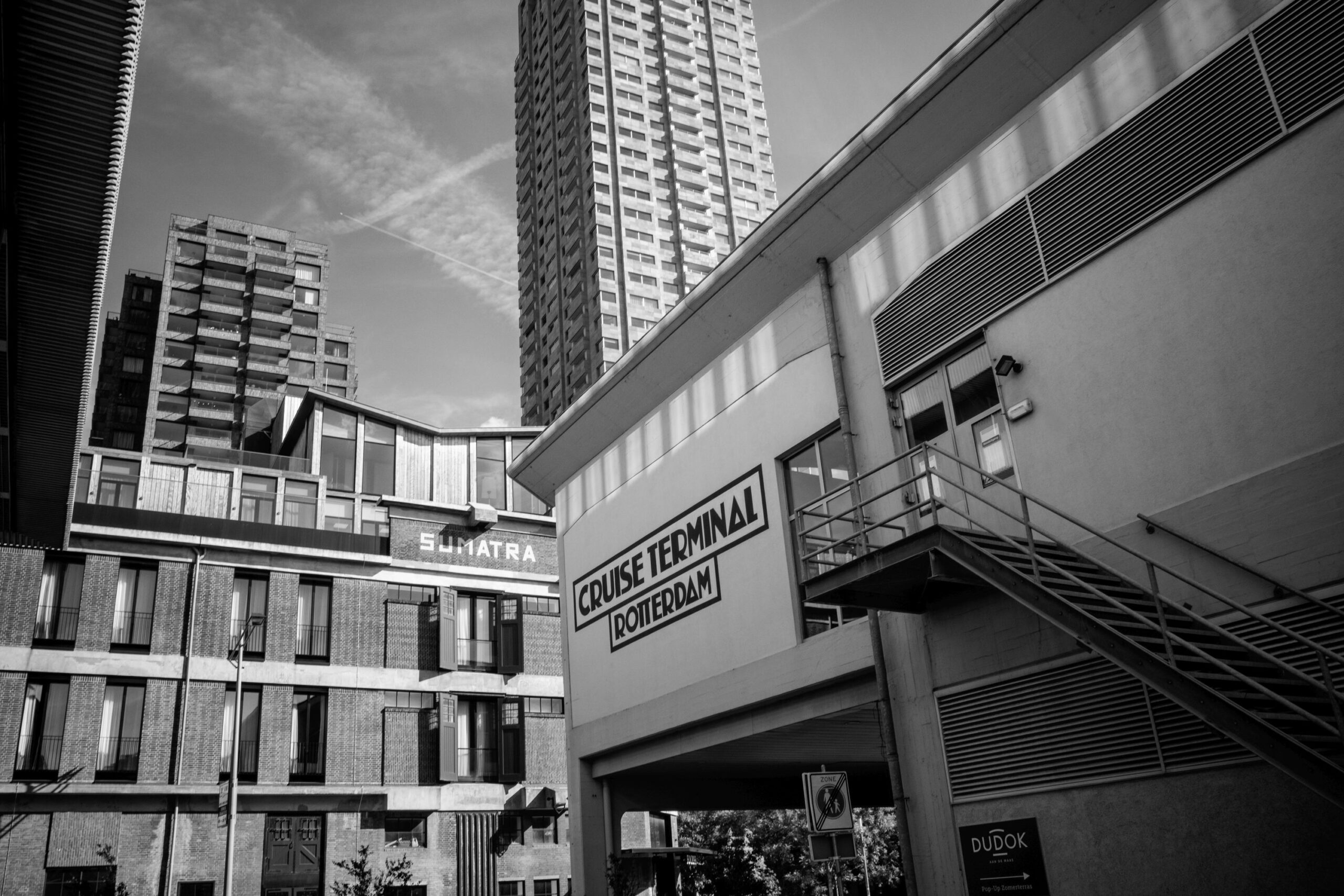
Complex Pakhuismeesteren sets the tone for this scene. Rotterdam loves a good contrast, and this photograph leans into it: a working waterfront gateway framed by sharp modern lines, with a single word—“Sumatra”—quietly tying the view to a much older story. Shot on the Wilhelminapier, it’s the kind of place where you can build a strong urban frame in seconds, then spend an hour waiting for the right human moment to walk through it.
Where This Photo Was Made (Sumatra)
You’re standing on the Wilhelminapier in Rotterdam’s Kop van Zuid, in the immediate orbit of the Cruise Terminal—a spot where working harbor infrastructure, tourist movement, and everyday foot traffic overlap. Across the open gap sits the warehouse block marked “Sumatra,” and it’s not just a nickname or a marketing flourish: The Sumatra Warehouse in Rotterdam is part of the Pakhuismeesteren complex (also known as the Celebes, Borneo, Java, and Sumatra warehouses) on the Wilhelminapier.
To find this angle, hug the terminal-side pedestrian space and look for a position where the terminal’s diagonal roofline and exterior stairs dominate the right half of the frame, while the Sumatra lettering lands clearly on the left.
.jpg)
A Terminal Built for Motion
Even in a still photograph, the terminal reads like a machine designed for movement. The staircase is a literal arrow; the railings repeat like a metronome; the vents and windows behave like grids that pull your eye forward. That’s why this is such a dependable street-photography stage: you can build a strong frame in seconds, then wait for life to happen inside it—someone cutting through beneath the overhang, a cyclist slipping past the signage, a figure pausing on the steps, a small group moving with purpose. The architecture does most of the heavy lifting: it gives you leading lines, depth, and a clean separation between foreground and background. Your job is to let the city supply the timing—a gesture, a stride, a glance upward that turns geometry into narrative.

“Sumatra” and the Warehouse That Refused to Disappear
The Pakhuismeesteren complex is one of those rare Rotterdam survivors: a heavy, practical building that still carries the visible evidence of what it used to be. It was originally a storage place for goods like tea and seeds, and while the use has changed, the identity has been intentionally preserved. The text painted on the facade—Celebes, Borneo, Java, Sumatra—functions like an urban caption, telling you that the pier’s past wasn’t decorative; it was operational.
In this photo, that single word “Sumatra” becomes a hinge between eras: an industrial memory across the gap from a contemporary terminal, with high-rise living stacked behind it. It’s Rotterdam in one sentence—repurpose, rebuild, keep the story visible.

The Names, the History, and What the City Chooses to Keep
The “Sumatra” lettering is more than a building label—it’s a surviving marker of how Rotterdam’s port once organized global trade. The roots of the Pakhuismeesteren tradition reach back to the period when Dutch overseas commerce was dominated by the VOC (Dutch East India Company). After the VOC era ended, the flows of tea and other colonial goods didn’t stop; they shifted into new commercial structures that still relied on Rotterdam’s harbor as a gateway. In 1818, Pakhuismeesteren van de Thee was founded to manage and continue parts of that Rotterdam trade and storage system, turning the waterfront into a carefully controlled chain of arrival, inspection, warehousing, and onward distribution.
The warehouse names—Celebes, Borneo, Java, Sumatra—make that history visible in plain text. They reference Indonesian islands tied to the former Dutch colonial world, and they reflect how goods, routes, and power relationships were once mapped onto the city’s infrastructure. What remains today is a kind of public archive: brickwork, scale, and typography that still carry the memory of an economy built on shipping, storage, and empire—preserved on the Wilhelminapier even as the surrounding skyline signals a very different Rotterdam.

From Closed Storage Block to Open, Public Ground Floor
One reason this area feels alive now is that Pakhuismeesteren didn’t just get cleaned up—it was strategically opened up. After the harbor activities ended in the 1980s, the building stood empty for years, and only after long uncertainty did a major restoration and transformation begin, turning a dark, inward-looking storage block into a mixed-use destination.
The renovation kept key elements—brick facades, concrete trim, visible time-wear, and the painted names—while adding new openings and internal light to make the building work for contemporary city life. Today, the complex supports hospitality, longer stays, and a lively ground-floor food concept that pulls people into the area beyond cruise days and tourist peaks.

How to Shoot This Spot Like Point ’n Shoot
For a Point ’n Shoot approach, start with what’s strongest: the signage and the lines. Place the CRUISE TERMINAL wall so it slices diagonally through your frame, then use the stairs as a secondary structure that invites a subject. Keep the Sumatra lettering readable across the gap—this is your “story anchor,” the detail that locks the image to Rotterdam’s waterfront identity. Then slow down.
The best frames here usually happen when a person briefly “activates” the geometry: someone stepping into the light under the terminal overhang, a silhouette on the stair landing, or a pair moving between old warehouse heritage and modern infrastructure. If you’re visiting, treat this corner as a repeatable location: shoot it once for architecture, then come back at a different time for people, weather, and shadow changes—each pass gives you a new version of the same stage.

Build your frame around environmental text (like a building name or sign), then wait for a human moment that adds meaning—a pause, a glance, a gesture, a crossing. Text gives context instantly; people give it emotion. If you can’t decide where to stand, choose the spot where the letters are clean and readable, and let the street deliver the rest.