Depot Boijmans sits at the crossroads of art, architecture, and everyday urban life in Rotterdam. Rising from the Museumpark, this reflective, bowl-shaped building is not only a museum depot but a constantly shifting urban scene. For street photographers, it offers something rare: a place where architecture, people, light, and movement collide in real time, creating endless visual narratives.
A New Perspective on Art and the City
Making the Invisible Visible
Depot Boijmans Van Beuningen is the world’s first publicly accessible art storage facility. Unlike traditional museums, where only a small fraction of the collection is on display, the Depot reveals what is usually hidden. More than 155,000 objects—from paintings and sculptures to prints and photography—are stored, preserved, and partially displayed in full view of the public.
_(1).jpg)
What was once hidden behind walls now becomes part of the street-level experience.
This philosophy mirrors the essence of street photography: observing what normally goes unnoticed and turning ordinary moments into meaningful images.
Architecture as an Urban Subject
A Building That Reflects the City
Designed by MVRDV, the 39.5-metre-high building has an ovoid, “in the round” form. Its façade is made up of 1,664 mirrored glass panels, covering over 6,600 square metres. These mirrors do more than reflect—they actively document the city.

Pedestrians, cyclists, trees, clouds, and the Rotterdam skyline constantly move across the surface, transforming the building into a living canvas. For street photographers, this creates opportunities for:
- Layered reflections and double scenes
- Abstract compositions shaped by movement
- Changing light throughout the day
- Human presence woven into architecture
Every step around the Depot offers a new frame.
Street Life at the Museum Entrance
Where the Museum Meets the Street
At ground level, the Depot maintains openness and flow. Its compact footprint preserves sightlines and walking routes through the Museumpark, allowing daily life to continue uninterrupted. This is where street photography thrives.

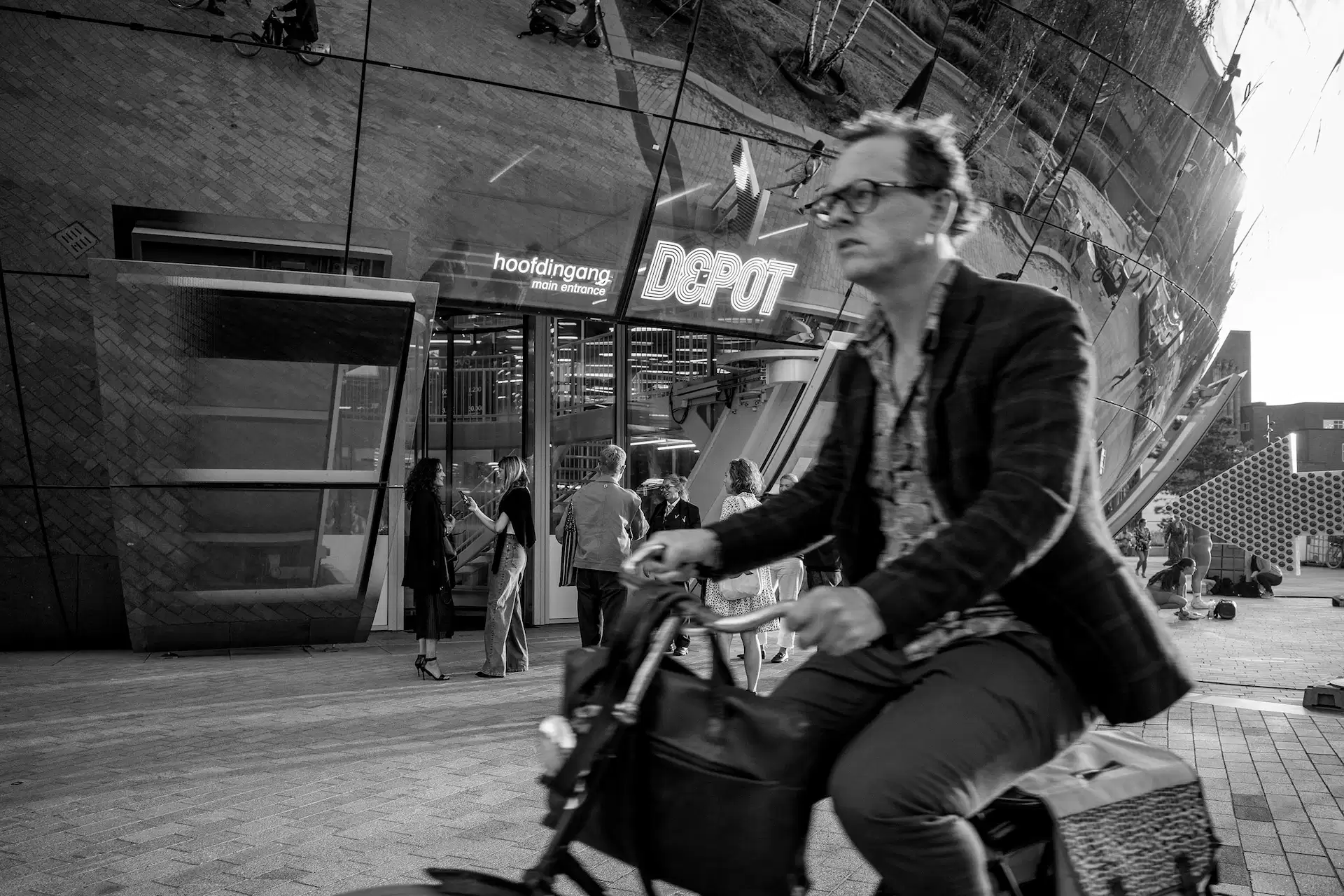
The main entrance becomes a natural stage. People gather, pass, pause, talk, wait. Cyclists cut through the scene. Reflections blur inside and outside, foreground and background.
The museum does not begin at the door—it begins on the street.
For photographers, this threshold captures the tension between motion and stillness, intention and coincidence.
Inside the Engine Room of Art
Art Storage as a Visual Experience
Inside, visitors move upward through a dramatic atrium using five zig-zagging staircases, inspired by the architectural etchings of Giovanni Battista Piranesi. Suspended within the space are 13 glass display vitrines, showing a lightly curated and constantly evolving selection from the collection.

Unlike traditional museum layouts, works are stored based on climatic requirements, not artistic movements or time periods. The building contains five distinct climate zones:
- Metal
- Plastic
- Organic / inorganic materials
- Black-and-white photography
- Colour photography
This approach highlights photography as both image and object—something material, fragile, and carefully preserved.
_(7).jpg)
Photography, Process, and Preservation
Behind the Scenes, in Plain Sight
The Depot reveals what usually remains unseen: conservation, restoration, packaging, and transport of artworks all happen within view. Visitors can observe specialists at work or request access to stored prints, drawings, and photographs.
For street and documentary photographers, this transparency resonates deeply.

Photography here is not just viewed—it is handled, protected, and maintained.
It reinforces the idea that images carry physical presence and long-term responsibility, not just visual impact.
A Rooftop Above the Urban Flow
A Forest with a View of Rotterdam
At the top of the building lies a rooftop forest, 35 metres above the city. Seventy-five multi-stemmed birch trees, along with grasses and firs, create a surprising contrast to the hard urban environment below. The rooftop terrace and restaurant offer wide views across Rotterdam.
_(9).jpg)
For photographers, this space provides:
- Panoramic cityscapes
- Juxtapositions of nature and concrete
- Light studies at sunrise and sunset
- A pause above the street rhythm

It is a place to step back, observe, and reset before returning to the city below.
A Democratic Landmark
A Building That Belongs to the City
Nearly 99 percent of Depot Boijmans is accessible to the public. Even the mirrored façade panels were adopted by citizens and institutions, making the building a collective project. The art collection belongs to the city of Rotterdam—and the Depot makes that ownership visible.
.jpg)
The city is both subject and participant.
For a street photography-focused platform, this makes the Depot more than architecture. It becomes a symbol of openness, observation, and shared space.
Seeing the City Differently
Depot Boijmans is not a static destination—it is an evolving street scene. Architecture responds to movement. Reflections shift with time and weather. People unknowingly complete the composition.
For street photographers, the Depot rewards patience and awareness. Whether capturing fleeting gestures at the entrance, layered reflections on the façade, or quiet moments above the city, it proves that urban photography is not about spectacle, but about seeing.
In Rotterdam, Depot Boijmans reminds us that the street itself is the exhibition.
One Reply to “Urban Geometry: Exploring the Depot Boijmans Rotterdam”
Comments are closed.